

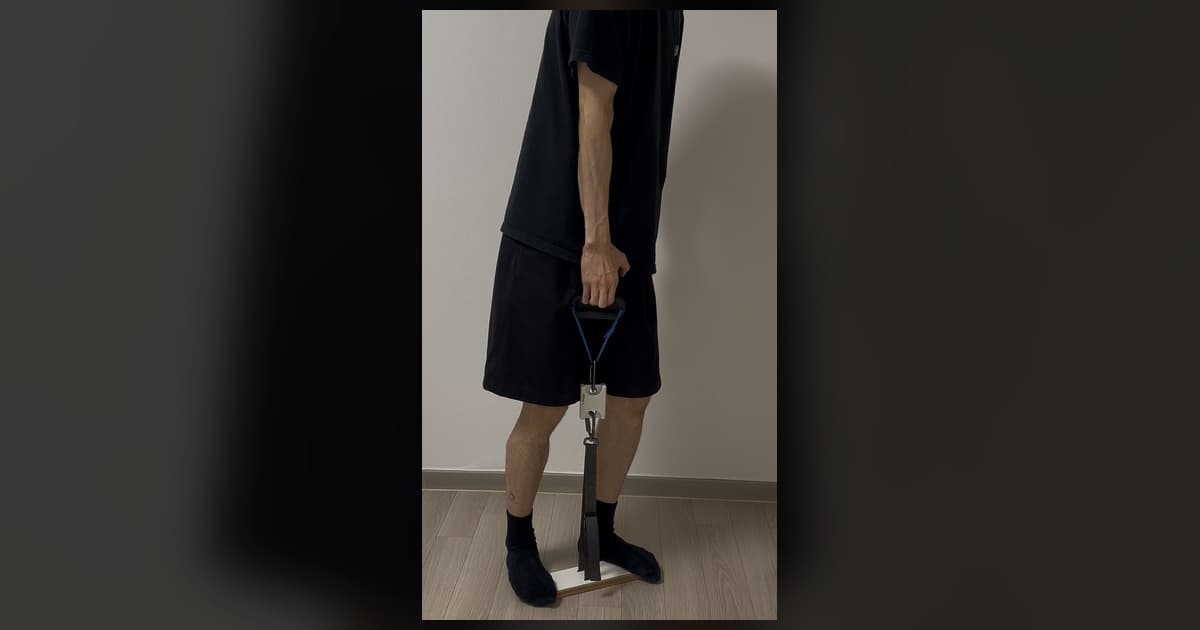
Frez is commonly used in a lifting-style overcoming-isometric setup: stand on the footplate, fix the strap length, press into the plate with your feet, and pull the handle upward. Frez does not lift a free weight; it provides nearly non-moving resistance. Aligning the direction of force and repeating the same posture makes records easier to compare. If this setup is new to you, start with the Passive Pull and Active Curl guide.
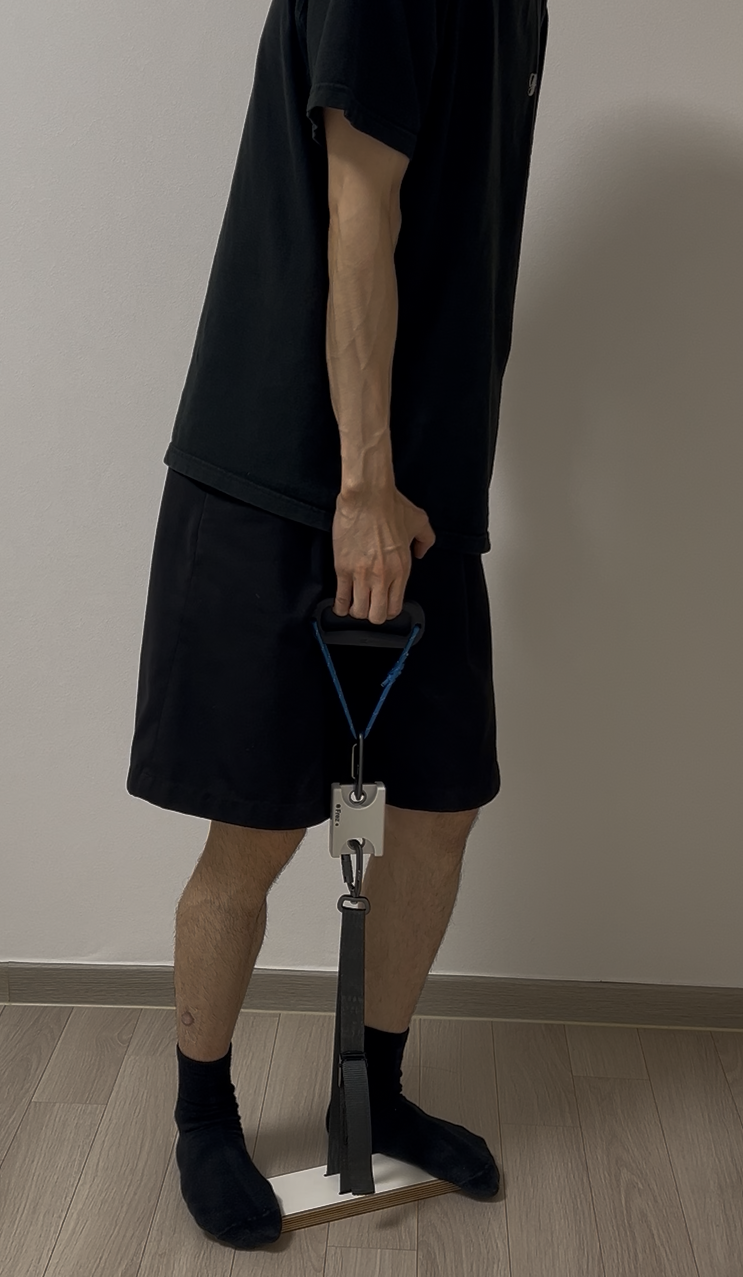
A side view of the Frez lifting setup. A single photo cannot show the movement or whether the position causes pain.
Is there one correct posture?
No single posture fits everyone in exactly the same way. Comfortable height and joint angles can vary with body proportions, arm length, handle choice, and training goal.
Use these three criteria instead:
- Check that your wrist, arm, and torso do not rotate unnecessarily as force rises.
- Keep the direction of force as straight as practical from the footplate through the strap and Frez to your hand.
- Make sure you can repeat the same foot position, strap length, and arm posture in the next session.
A comfortable posture you can reproduce is more useful for comparing records than a posture that produces one unusually high number. The guide to isometric training explains the underlying setup in more detail.
What to take from Yves's lifting posture
Starting at 6:19 in the Lattice Training video, Yves Gravelle explains that the load should sit below the shoulder and armpit, close to the body's center, with the pulling arm aligned with or just in front of the midline. The key is to keep the arm from drifting outward and to lift with the legs.
From 7:28 to 8:00, he also advises against bending the elbow or shrugging while pulling and explains how to set the pin length so that knee extension supplies most of the force. With Frez, you can apply the same principle by adjusting the strap before the attempt and watching whether your elbow angle changes during it.
Frez does not lift a free weight from the floor, so use this video only as a reference for directing force. Keeping the hand, Frez, strap, and footplate close to one line can make the setup easier to repeat.
This posture cannot be guaranteed to prevent injury. Do not force the shoulder down or pin the arm to your torso. Work within a comfortable, pain-free range.
Does the posture in the photo look reasonable?
In the attached side-view photo, the pulling arm is close to the torso and the elbow appears extended. The wrist, forearm, handle, Frez, strap, and footplate also appear approximately aligned.
However, one still image cannot verify shoulder elevation, torso lean, wrist rotation, pain, or whether the same form is maintained at peak force. If possible, record a short side-view video of the entire force ramp and review it.
Frez lifting posture checklist
Feet and footplate
- Press into the footplate steadily with both feet.
- Repeat the same stance width and position on the plate.
- At peak force, check that the plate does not tip and that one foot does not shift.
Wrist, arm, and shoulder
- Hold the handle so the wrist and forearm connect naturally.
- Keep the arm close to your body without forcing it inward.
- As force rises, avoid shrugging or adding a new bend at the elbow.
Strap and torso
- Set Frez and the strap so they do not tilt far to the side.
- Fix the strap at a height that lets knee extension provide most of the force without requiring an initial elbow bend or shrug.
- Do not twist or lean the torso far backward to raise the number.
Release the force and stop the measurement immediately if you feel pain or tingling.
Compare records made in the same posture
Measurements can change when handle position, strap length, stance width, elbow angle, or the use of the shoulder and torso changes. Record at least:
- The hand and grip used
- Handle or edge type
- Strap length
- Foot and free-hand positions
- Elbow and shoulder posture
- How force was started and the measurement duration
To track change, compare records made with the same setup. For the purpose and recording of maximum-force tests, continue with the MVC guide.
Frequently asked questions
Must the elbow be completely straight?
You do not need to use one universal angle. However, if the elbow angle changes during an attempt, arm contribution and the measurement may change too. Choose a comfortable starting angle and maintain it.
Is the posture that produces the highest number the best posture?
A high number produced by changing posture is difficult to compare directly with earlier records. When tracking training changes, repeatable conditions matter more than a single maximum number.
Can posture be checked from a photo alone?
A photo can show approximate alignment of the feet, arm, and equipment, but it cannot verify shoulder elevation, wrist rotation, torso movement at peak force, or pain. Record the full force ramp from the side when possible.
Summary
For Frez lifting posture, three criteria matter more than one universal shape: you should be able to produce force comfortably, the force path should not be substantially twisted, and you should be able to repeat the same setup at the next measurement.
Begin at low intensity and set your feet, strap, wrist, and shoulder positions. Once the posture feels settled, record the strap length and foot position and compare only records made under the same conditions.
Sources
- Lattice Training — Yves Arm-Lifting Method, 6:19
- C4HP / Tyler Nelson — Finger Strength Training 4 Rock Climbing, 6:29
- StrengthClimbing — The Best Finger Strength Protocol for Rock Climbing, 0:59
Video titles and captions checked on August 25, 2026 (KST).
